Describe this image here

CREED MEDIA

Redesigning a fragmented internal workflow into one creator-campaign system.

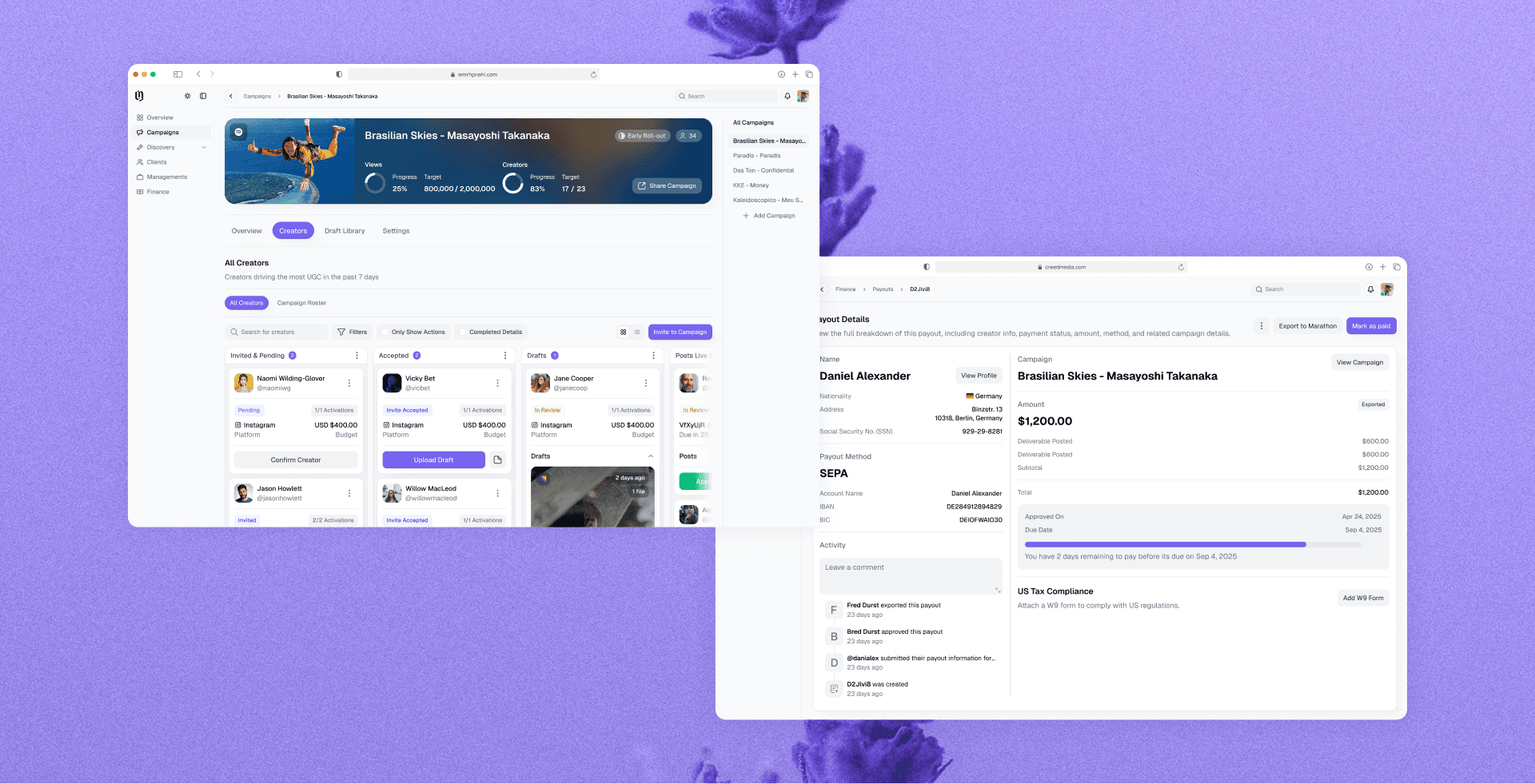
Creed Media's campaigns ran on an internal tool that the company's own managers use every day to discover creators, set pricing, send invitations, and manage activations. I led the end-to-end redesign: a new design system and unified visual language, plus a rebuild of the core features managers depend on daily. The goal was an internal product that feels intuitive, holds up under heavy campaign load, and matches how the team actually works.

Role

Senior Product Designer

Industry

Internal Tooling · CreatorTech · MusicTech

PLATFORM

iOS & Android

Year

2025

The problem

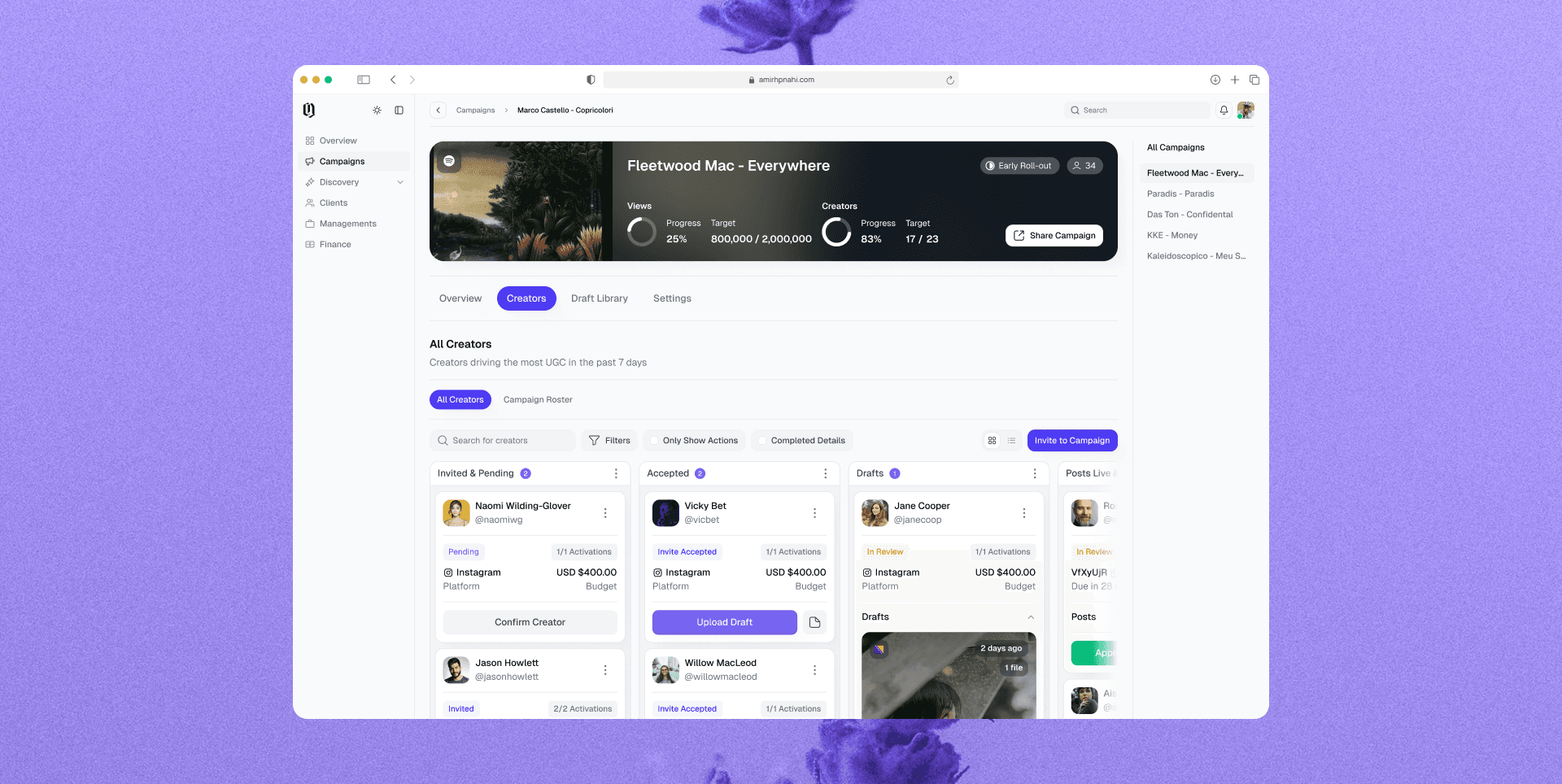
The team's campaign managers were running multi-campaign workflows across disconnected internal tools: CSV files, external spreadsheets, and fragmented screens. Every new campaign meant repeating the same manual setup, with no shared system, no unified discovery, and no single place to handle pricing and invitations.

Two constraints shaped the work. I couldn't rip out the tools people already relied on, and different teams needed to keep their own autonomy. So the challenge was consolidating the chaos into one cohesive, scalable internal platform without forcing everyone onto a rigid new system overnight.
Describe this image here

What was done

Research and insights

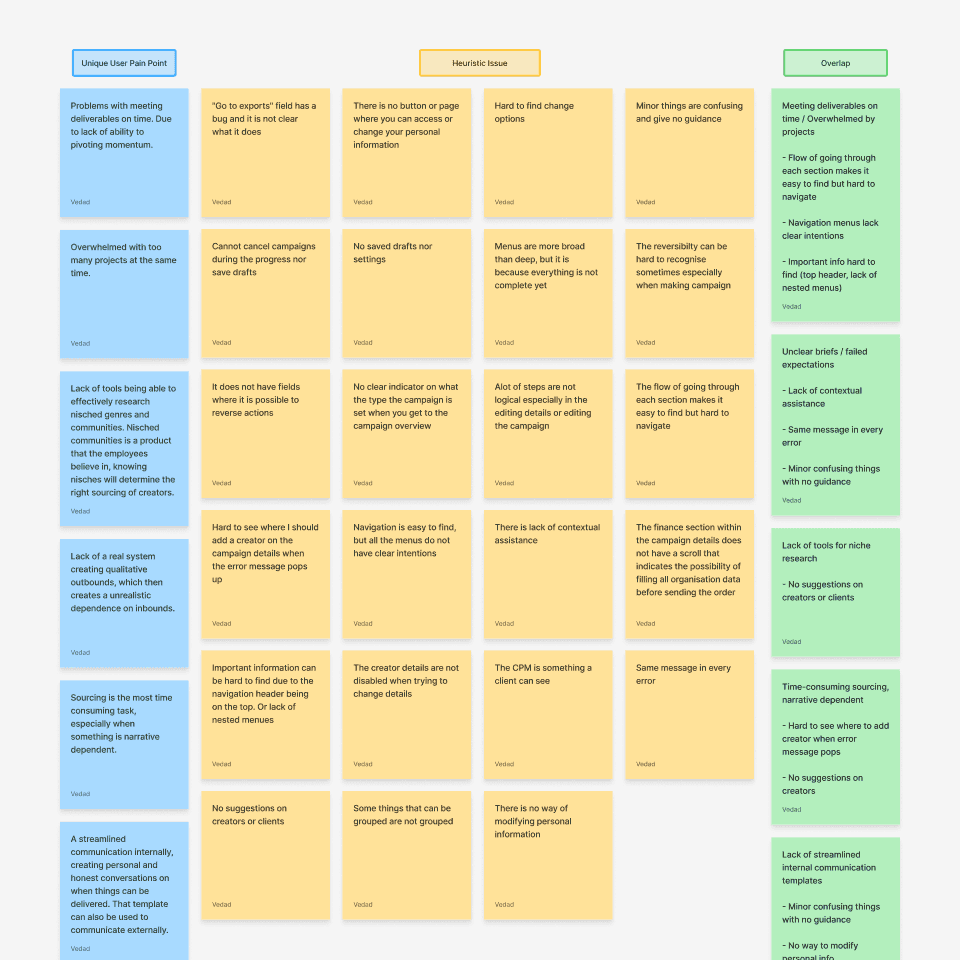
Before redesigning anything, I took stock of the existing research, heuristic evaluations, prior interviews, and predefined personas, then synthesized it into structured insights and ran my own UX audit on top to validate the findings and surface friction the earlier work had missed.

From that synthesis, Lena emerged: a senior campaign manager at an indie label, fast and intuitive and close to her creators, but slowed by her own tools. As she put it, when she's adding creators she needs to see whether she's still within budget right there, not on another page. Her day mixes discovery, negotiation, and activation, and every task felt like context switching.

Her frustrations clustered into four areas: overload and context switching from juggling many projects, slow and incomplete discovery in niche genres, time-intensive sourcing and vetting that bottlenecked campaigns before they started, and budget and rate uncertainty from inconsistent, non-transparent pricing.


Approach and prioritization

To turn insights into action, I produced two tracks: Quick Wins from the existing research, and Quick Wins from my own UX audit, which double-validated the findings and caught overlooked friction. I mapped every item on a Priority Matrix by impact versus effort, separating immediate actions from mid-term and long-term bets.
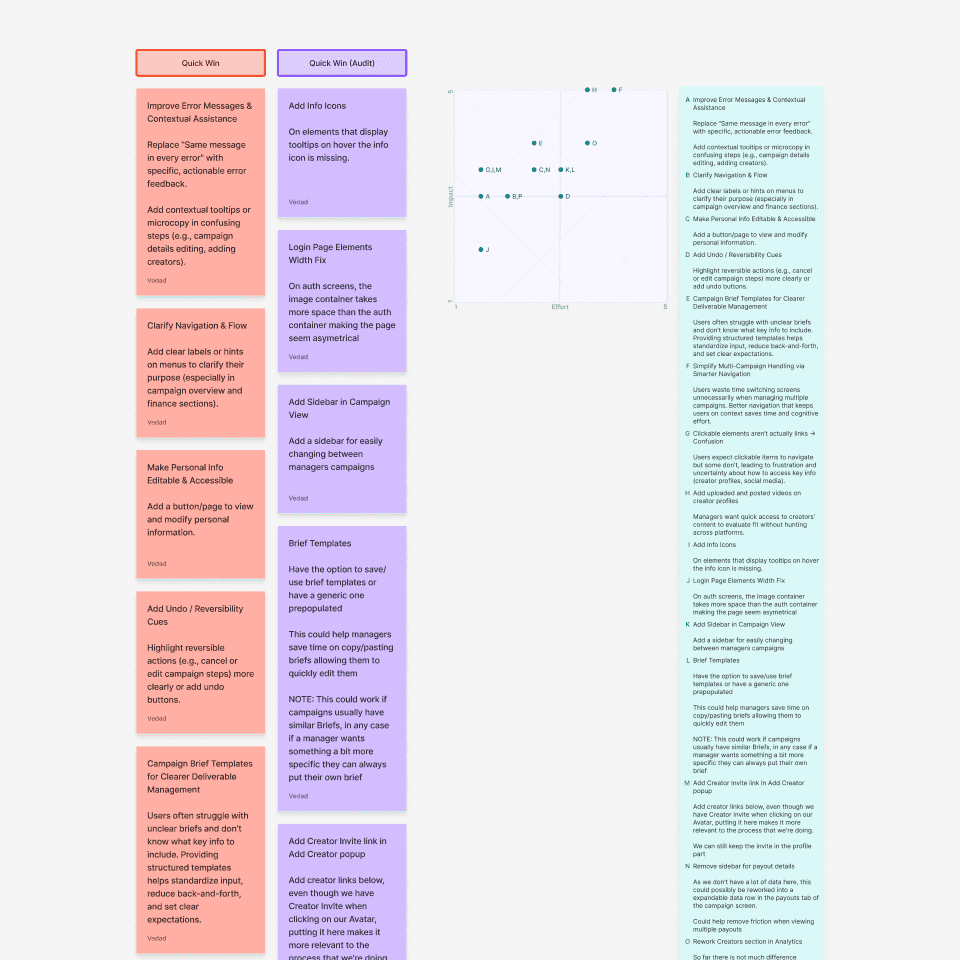
The matrix pointed to two focus areas: streamlined campaign management (cutting context switching for managers running 10 to 12 campaigns at once) and seamless creator discovery and evaluation (keeping sourcing and vetting inside the platform instead of in spreadsheets and browser tabs).


The Solution

With Lena's voice guiding the work, I unified discovery, invitation, and activation into one continuous, context-rich flow. Three shipped pieces carried it.



Seamless invitations

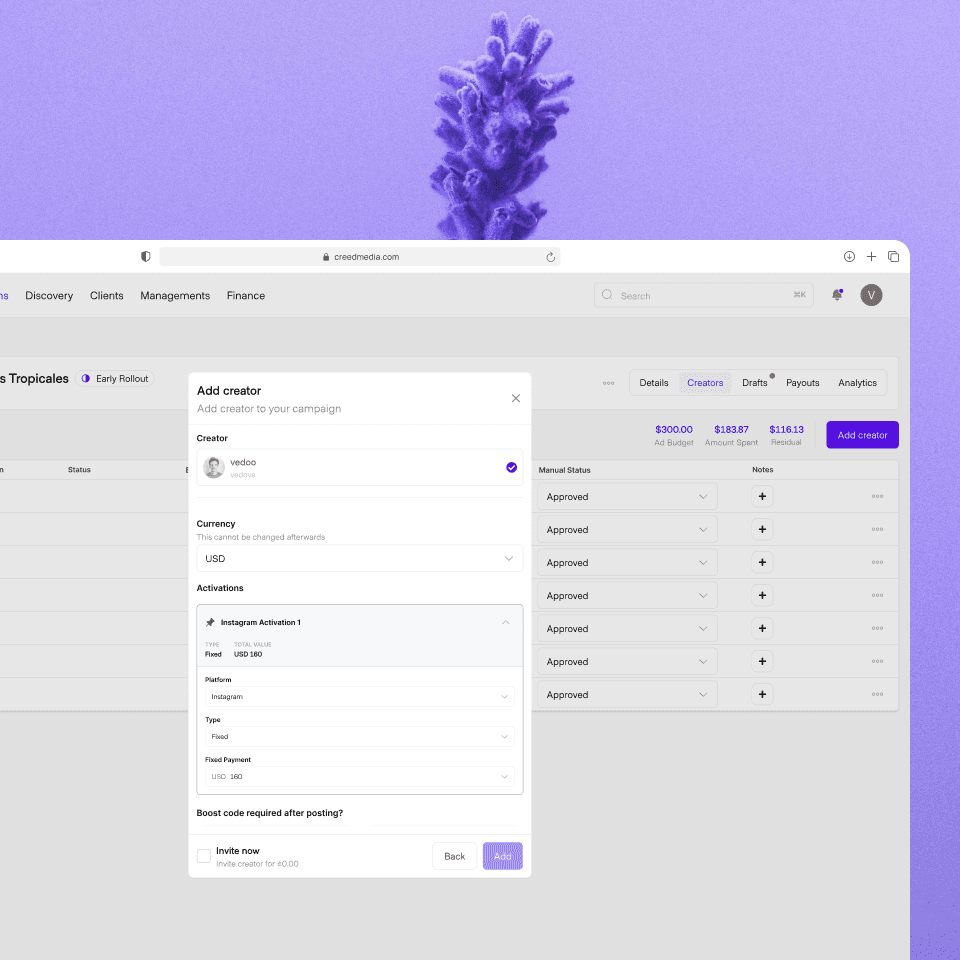
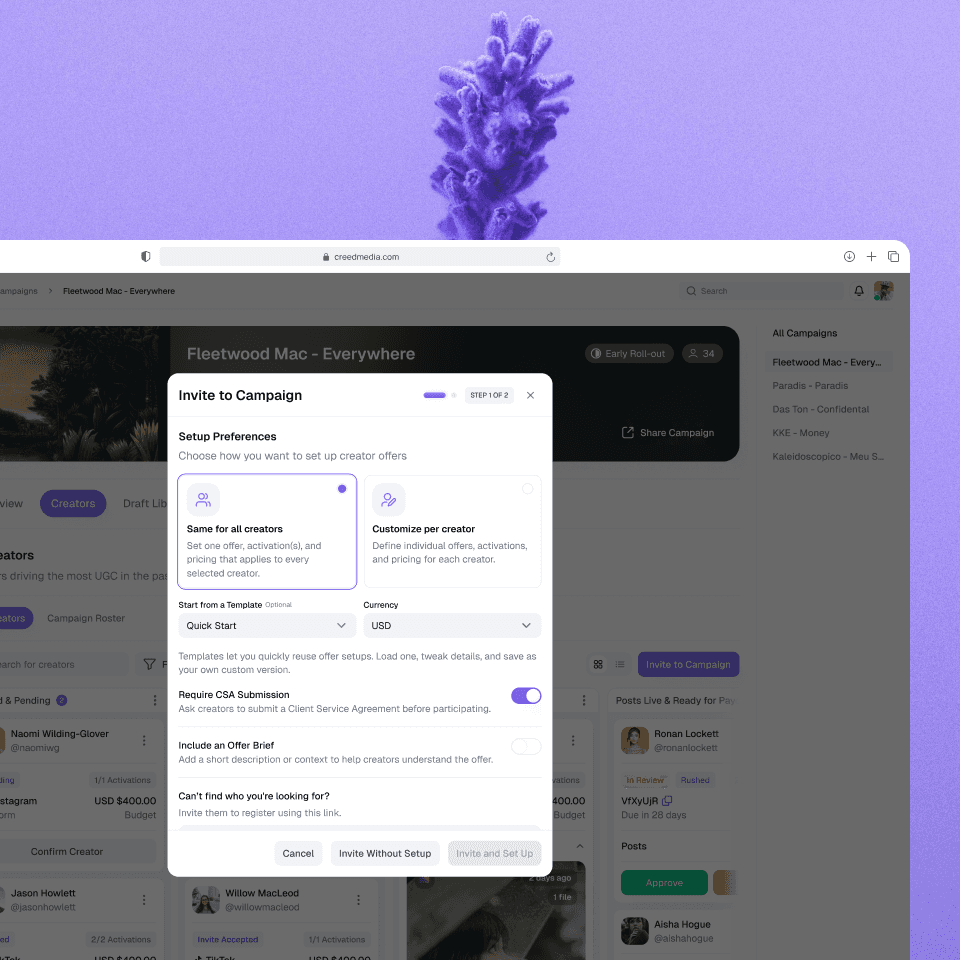
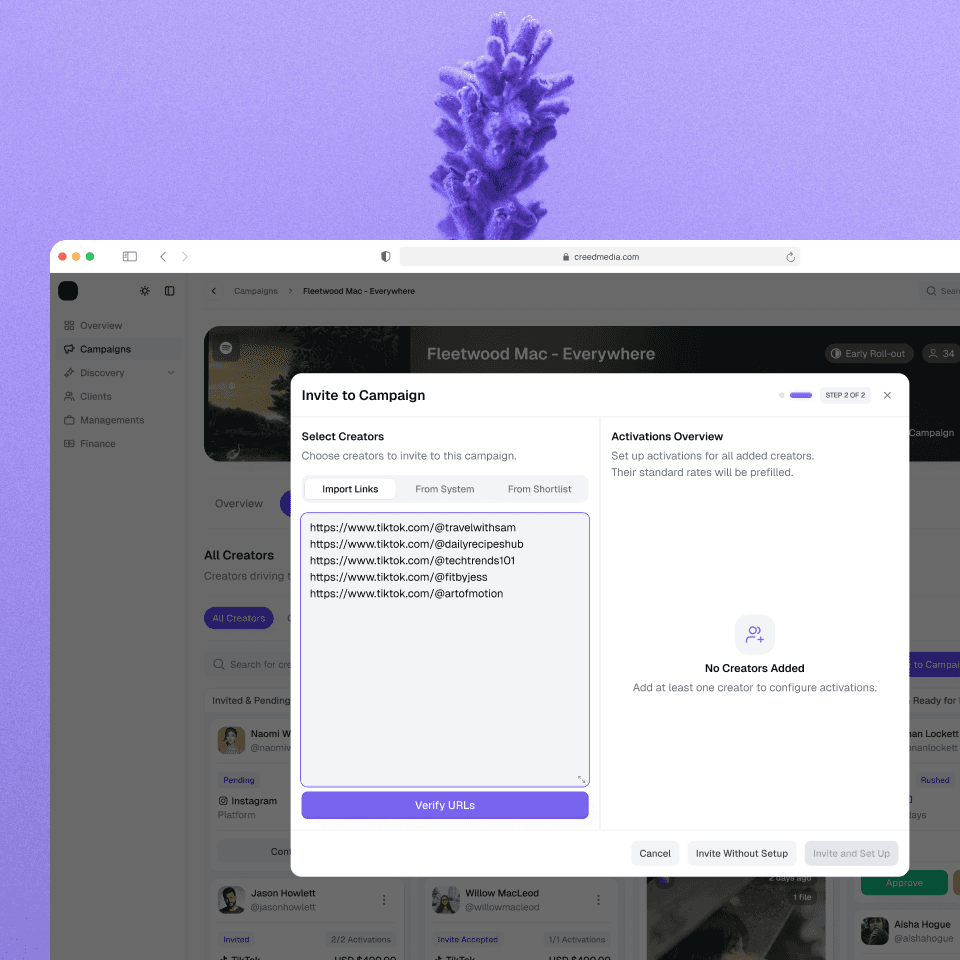
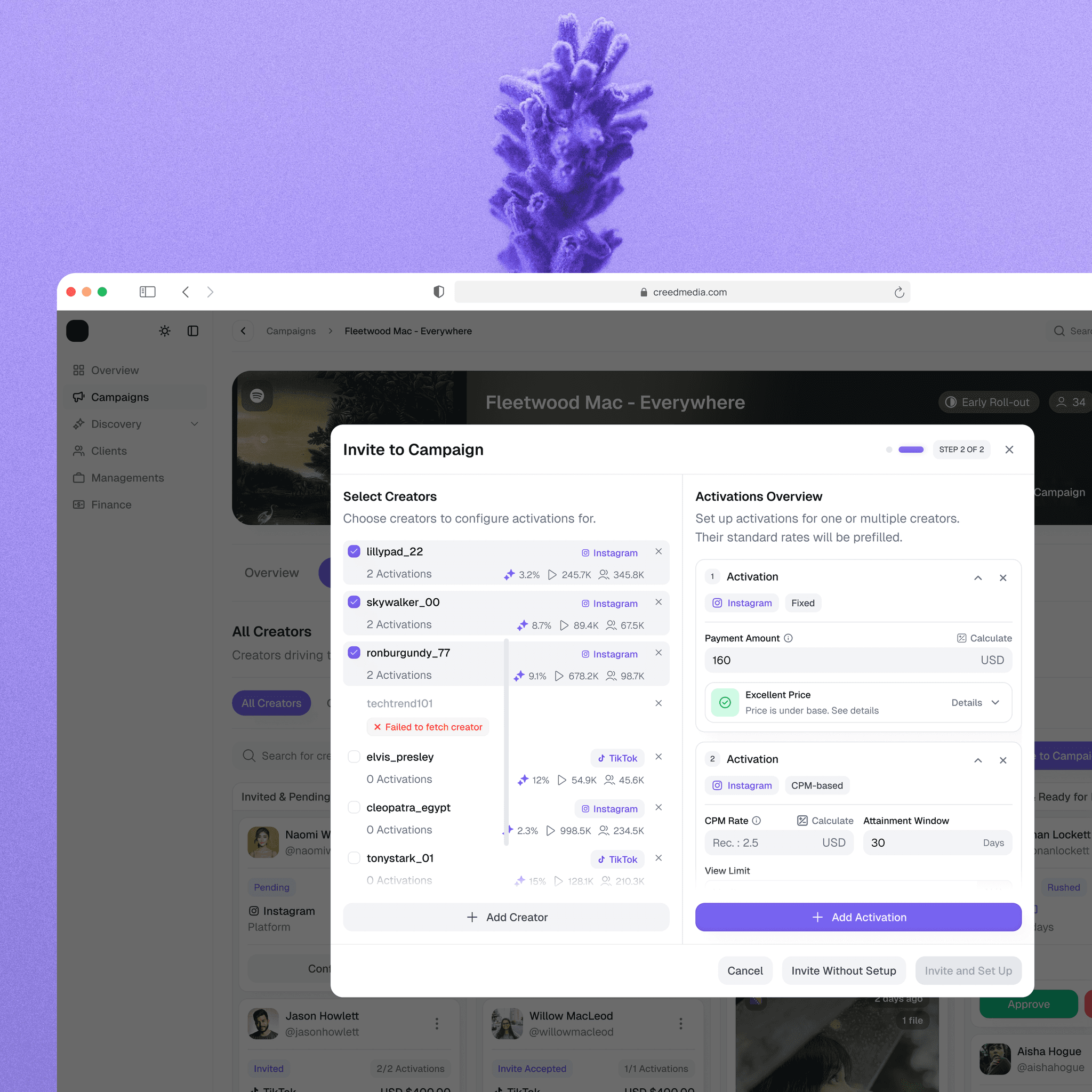
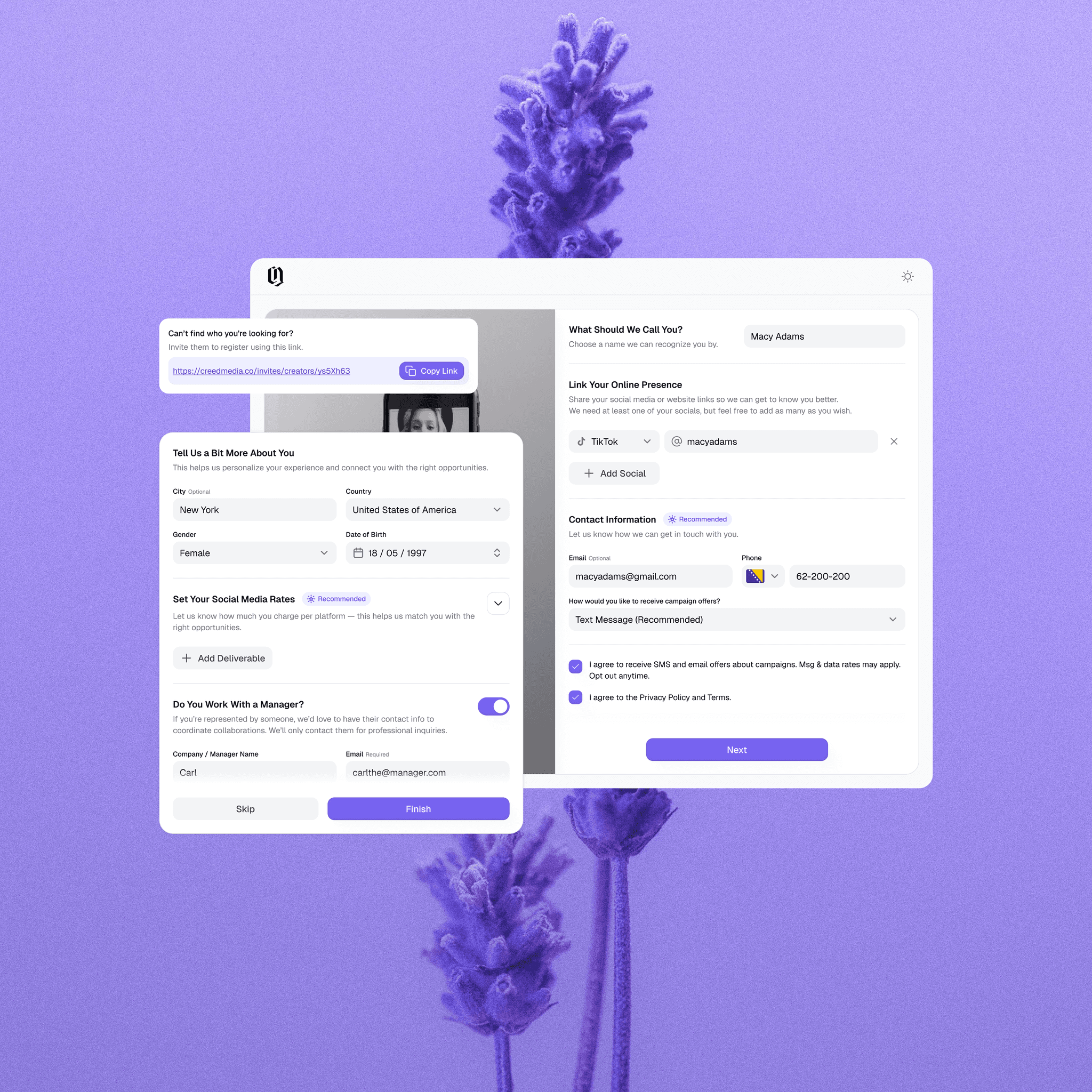
I redesigned the Invite to Campaign modal to handle every way managers add creators in one interface: CSV import, the internal database, and existing shortlists, all without leaving the modal. Creators can also self-serve through a shareable link, configuring their own activations, pricing, and details while managers keep full oversight, so a small change no longer means rebuilding the whole setup.
Pricing without guesswork

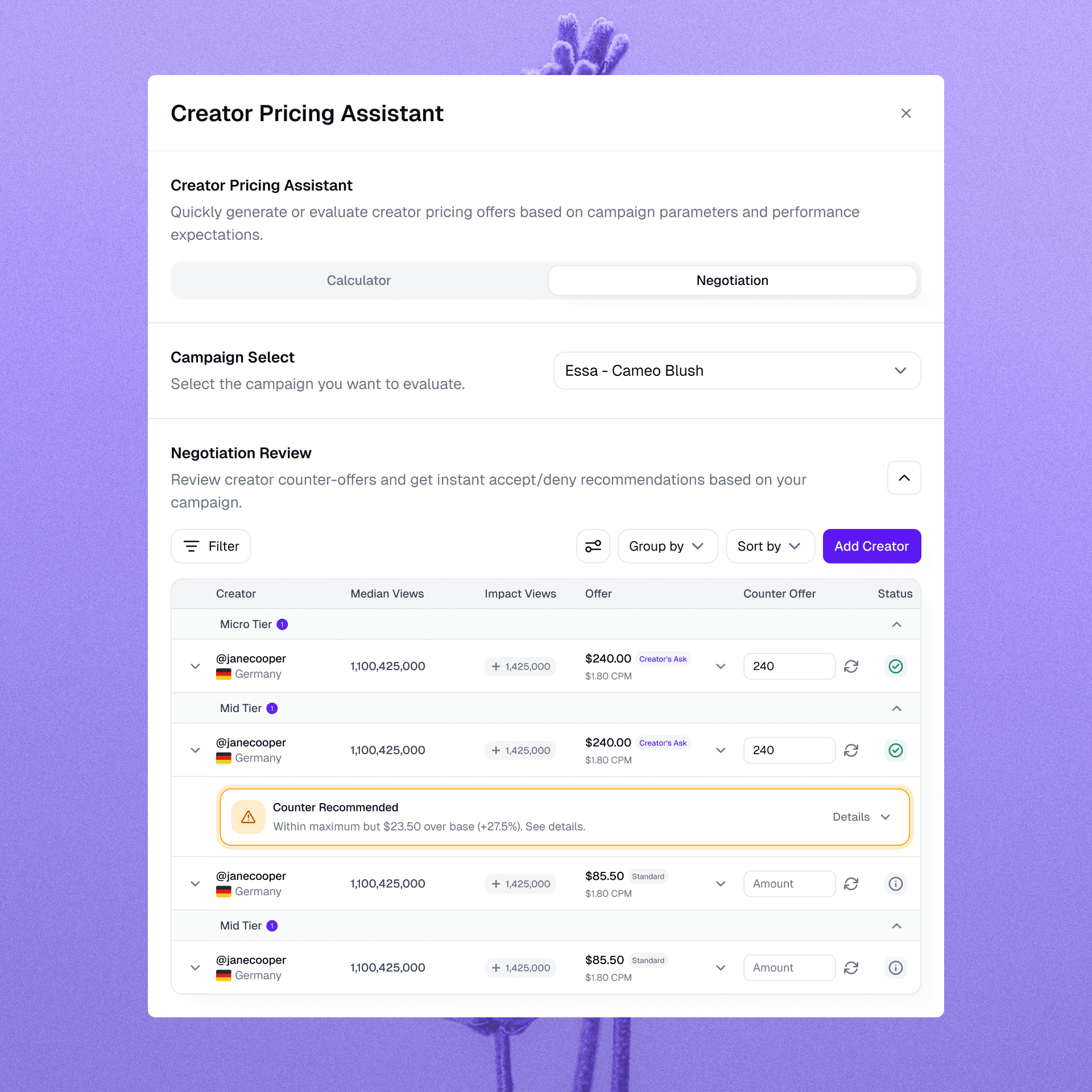
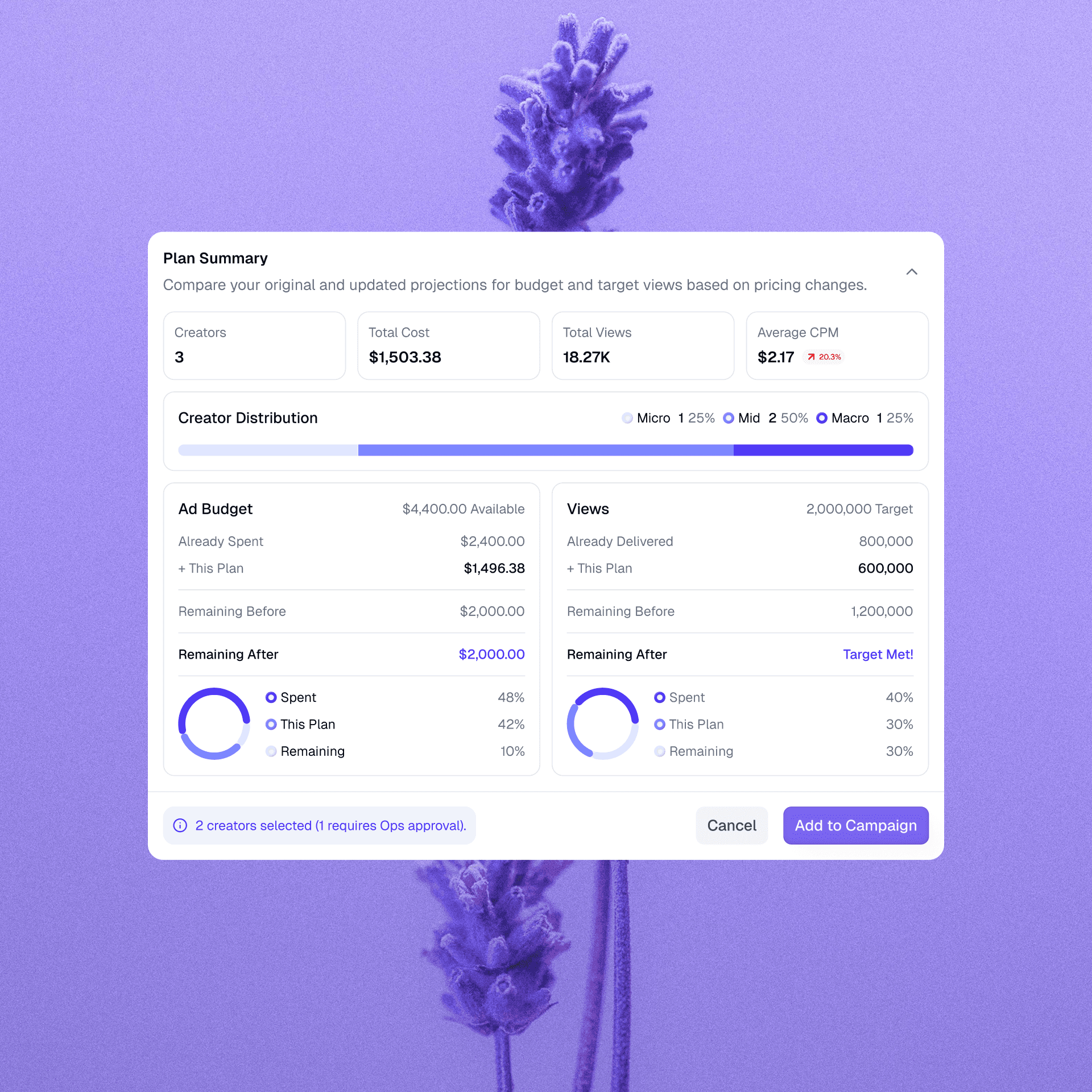
The Creator Pricing Assistant embeds pricing into the workflow. It shows each creator's live impact on the total budget, predicts reach and engagement from historical data, and benchmarks the rate against internal standards, with inline approval prompts for high-value creators so managers never break flow. Everything recalculates live as prices change.

Discovery that thinks with you

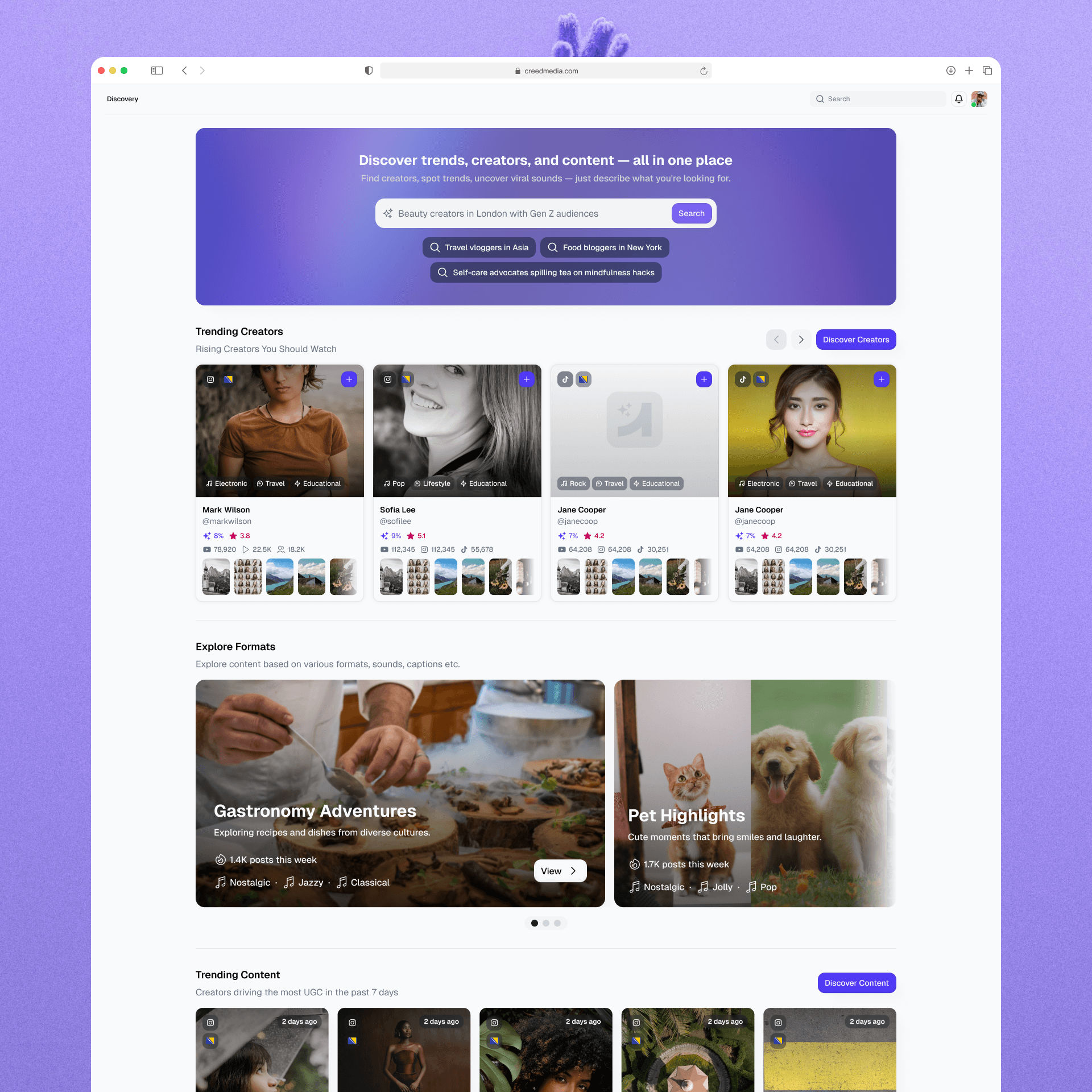
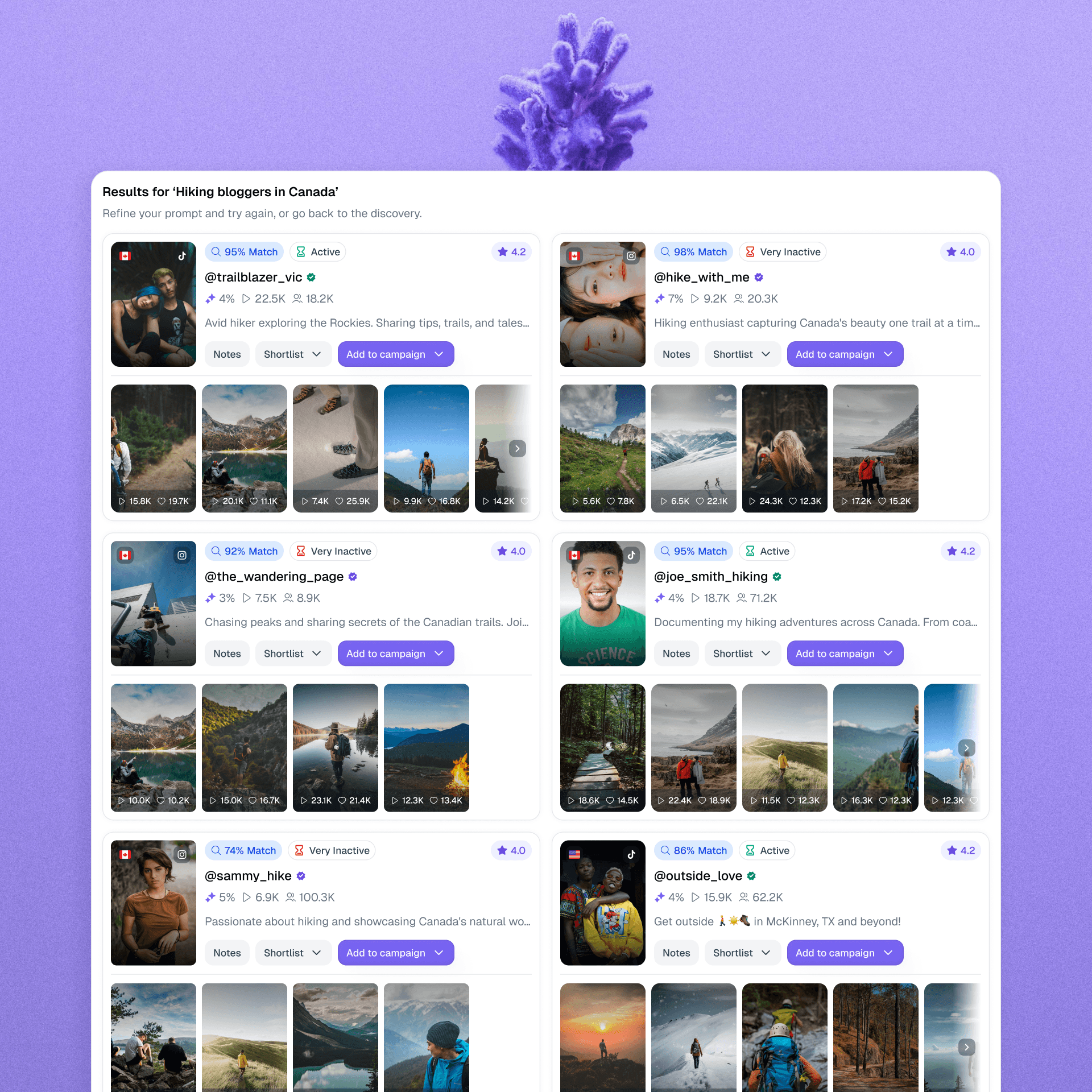
AI Creator Discovery replaces rigid handle-and-filter search with natural-language prompts like "find pop artists in London with high engagement on Reels."

It returns a curated list with transparent reasoning: relevance scoring across genre, audience overlap, and engagement, confidence indicators, recent in-platform activity, and quick actions to add creators to campaigns or shortlists.

This opened up niche genres and micro-communities that were previously almost impossible to source.
The result

The team moved from fragmented tools and manual spreadsheets to one unified, intelligent creator-management platform. Managers now move through discovery, pricing, and invitations without losing context, which removes most of the repetitive setup that used to eat the start of every campaign.

Natural-language discovery and in-platform insights cut the constant cross-checking against external sources and made niche sourcing genuinely feasible. Transparent pricing, live budget impact, and inline approvals let managers decide with clarity instead of guesswork.

The system holds up under 10 to 12 concurrent campaigns, and creators get a simpler self-serve experience that reduces back-and-forth.

For an internal product, the clearest signal of success was the shift in how the work feels: what used to be a tedious, error-prone setup spread across spreadsheets became a single continuous flow, meaningfully reducing setup time and freeing managers to focus on the campaigns themselves rather than the admin around them.
Describe this image here

CREED MEDIA

Redesigning a fragmented internal workflow into one creator-campaign system.

Creed Media's campaigns ran on an internal tool that the company's own managers use every day to discover creators, set pricing, send invitations, and manage activations. I led the end-to-end redesign: a new design system and unified visual language, plus a rebuild of the core features managers depend on daily. The goal was an internal product that feels intuitive, holds up under heavy campaign load, and matches how the team actually works.

Role

Senior Product Designer

Industry

Internal Tooling · CreatorTech · MusicTech

PLATFORM

iOS & Android

Year

2025

The problem

The team's campaign managers were running multi-campaign workflows across disconnected internal tools: CSV files, external spreadsheets, and fragmented screens. Every new campaign meant repeating the same manual setup, with no shared system, no unified discovery, and no single place to handle pricing and invitations.

Two constraints shaped the work. I couldn't rip out the tools people already relied on, and different teams needed to keep their own autonomy. So the challenge was consolidating the chaos into one cohesive, scalable internal platform without forcing everyone onto a rigid new system overnight.

Describe this image here

What was done

Research and insights

Before redesigning anything, I took stock of the existing research, heuristic evaluations, prior interviews, and predefined personas, then synthesized it into structured insights and ran my own UX audit on top to validate the findings and surface friction the earlier work had missed.

From that synthesis, Lena emerged: a senior campaign manager at an indie label, fast and intuitive and close to her creators, but slowed by her own tools. As she put it, when she's adding creators she needs to see whether she's still within budget right there, not on another page. Her day mixes discovery, negotiation, and activation, and every task felt like context switching.

Her frustrations clustered into four areas: overload and context switching from juggling many projects, slow and incomplete discovery in niche genres, time-intensive sourcing and vetting that bottlenecked campaigns before they started, and budget and rate uncertainty from inconsistent, non-transparent pricing.


Approach and prioritization

To turn insights into action, I produced two tracks: Quick Wins from the existing research, and Quick Wins from my own UX audit, which double-validated the findings and caught overlooked friction. I mapped every item on a Priority Matrix by impact versus effort, separating immediate actions from mid-term and long-term bets.


The matrix pointed to two focus areas: streamlined campaign management (cutting context switching for managers running 10 to 12 campaigns at once) and seamless creator discovery and evaluation (keeping sourcing and vetting inside the platform instead of in spreadsheets and browser tabs).


The Solution

With Lena's voice guiding the work, I unified discovery, invitation, and activation into one continuous, context-rich flow. Three shipped pieces carried it.


Seamless invitations

I redesigned the Invite to Campaign modal to handle every way managers add creators in one interface: CSV import, the internal database, and existing shortlists, all without leaving the modal. Creators can also self-serve through a shareable link, configuring their own activations, pricing, and details while managers keep full oversight, so a small change no longer means rebuilding the whole setup.


Pricing without guesswork

The Creator Pricing Assistant embeds pricing into the workflow. It shows each creator's live impact on the total budget, predicts reach and engagement from historical data, and benchmarks the rate against internal standards, with inline approval prompts for high-value creators so managers never break flow. Everything recalculates live as prices change.


Discovery that thinks with you

AI Creator Discovery replaces rigid handle-and-filter search with natural-language prompts like "find pop artists in London with high engagement on Reels."

It returns a curated list with transparent reasoning: relevance scoring across genre, audience overlap, and engagement, confidence indicators, recent in-platform activity, and quick actions to add creators to campaigns or shortlists.

This opened up niche genres and micro-communities that were previously almost impossible to source.


The result

The team moved from fragmented tools and manual spreadsheets to one unified, intelligent creator-management platform. Managers now move through discovery, pricing, and invitations without losing context, which removes most of the repetitive setup that used to eat the start of every campaign.

Natural-language discovery and in-platform insights cut the constant cross-checking against external sources and made niche sourcing genuinely feasible. Transparent pricing, live budget impact, and inline approvals let managers decide with clarity instead of guesswork.

The system holds up under 10 to 12 concurrent campaigns, and creators get a simpler self-serve experience that reduces back-and-forth.

For an internal product, the clearest signal of success was the shift in how the work feels: what used to be a tedious, error-prone setup spread across spreadsheets became a single continuous flow, meaningfully reducing setup time and freeing managers to focus on the campaigns themselves rather than the admin around them.

Describe this image here

Open to New Projects

I'm Always open to discussing new ideas, products, or problems worth solving.

If there’s something interesting to explore or build together, let’s talk.

Open to New Projects

I'm Always open to discussing new ideas, products, or problems worth solving.

If there’s something interesting to explore or build together, let’s talk.

Open to New Projects

I'm Always open to discussing new ideas, products, or problems worth solving.

If there’s something interesting to explore or build together, let’s talk.